Real-Time Left Ventricular Surrogate
A computational surrogate for rapid estimation and visualization of left ventricular hemodynamics.
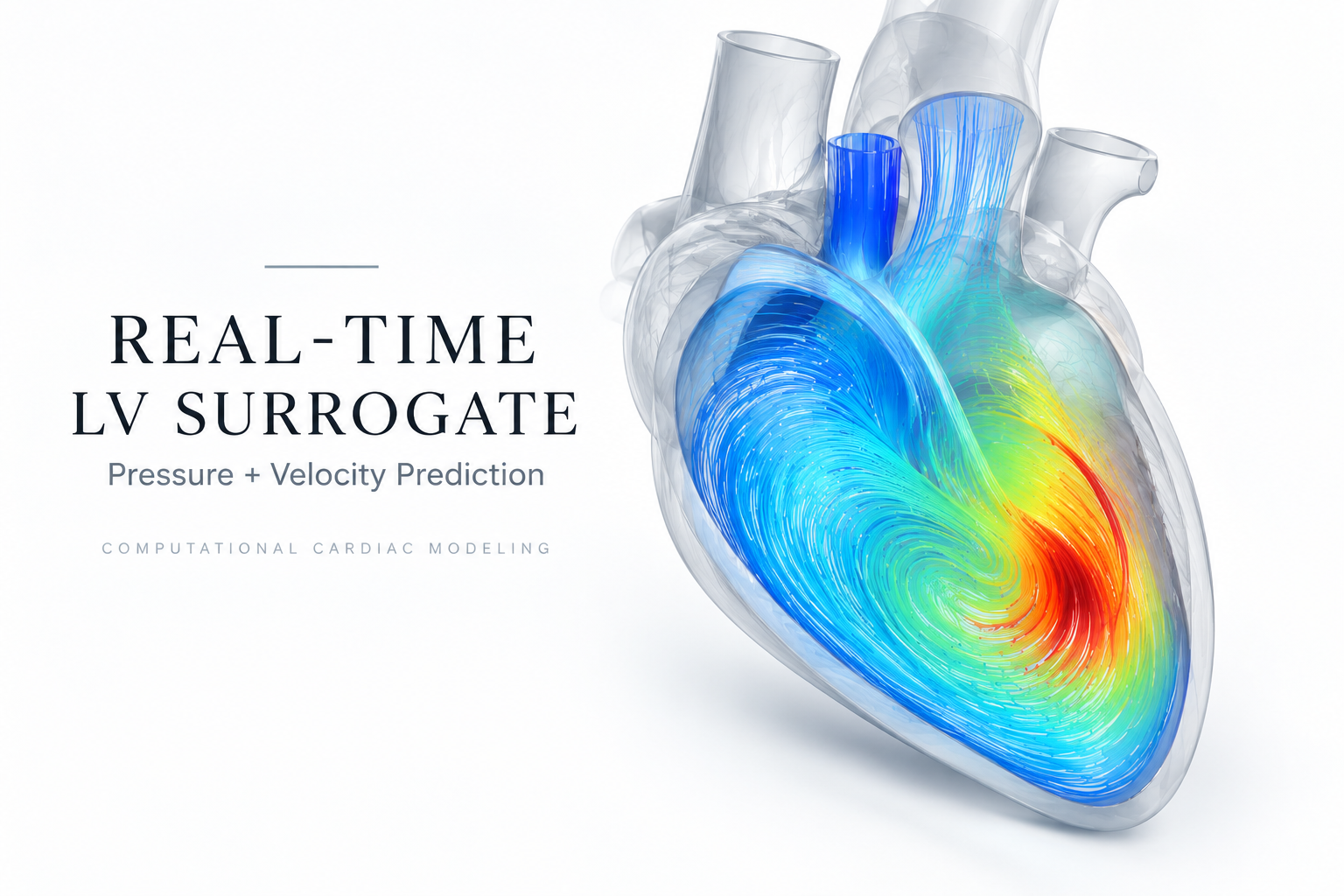
Project Overview
The Real-Time Left Ventricular Surrogate addresses the computational cost associated with repeatedly performing high-fidelity computational fluid dynamics simulations for cardiovascular analysis. Although CFD provides detailed information about blood-flow behaviour within the left ventricle, repeated simulations can be computationally demanding and unsuitable for applications requiring rapid prediction.
The project uses deep learning to construct a surrogate model that learns the relationship between simulation conditions and corresponding left ventricular hemodynamic outputs. CFD-generated data is used to train the model to approximate pressure and velocity fields, allowing new predictions to be generated substantially faster than performing a complete numerical simulation for each case.
By combining cardiovascular modelling, CFD-derived datasets, neural surrogate modelling, and scientific visualization, the system explores how data-driven methods can complement conventional numerical simulation and support faster analysis of left ventricular hemodynamics.
Technology Stack
- Python
- Deep Learning
- Neural Networks
- Computational Fluid Dynamics
- Scientific Computing
- Hemodynamic Modelling
- Scientific Visualization
System Architecture
The system transforms CFD-derived cardiovascular simulation data into a learning pipeline that trains a neural surrogate to rapidly approximate left ventricular hemodynamic fields.
- CFD Simulation Data — provides high-fidelity left ventricular hemodynamic data used for surrogate training.
- Data Processing Layer — prepares physiological and simulation-derived parameters for model development.
- Surrogate Learning Model — learns the relationship between simulation inputs and corresponding hemodynamic outputs.
- Prediction Engine — generates rapid approximations of left ventricular pressure and velocity fields.
- Visualization Layer — presents predicted hemodynamic fields for analysis and comparison.
System Workflow
- Left ventricular CFD simulations are used to generate reference hemodynamic data.
- Simulation parameters and corresponding output fields are extracted and prepared for model training.
- The dataset is processed and supplied to the neural surrogate model.
- The surrogate learns mappings between simulation conditions and resulting hemodynamic fields.
- New physiological or simulation parameters are provided to the trained model.
- The model rapidly predicts corresponding pressure and velocity fields.
- Predicted outputs are visualized and compared with CFD-derived reference results.
Key Features
- Real-time approximation of computationally expensive CFD outputs.
- Prediction of left ventricular pressure and velocity fields.
- Deep-learning-based surrogate modelling.
- Integration of CFD-generated data with machine learning.
- Rapid inference for repeated hemodynamic analysis.
- Scientific visualization of predicted cardiovascular flow fields.
Results
- Developed a neural surrogate for rapid approximation of left ventricular hemodynamic fields.
- Reduced reliance on repeated computationally expensive CFD simulations during prediction.
- Enabled rapid prediction of pressure and velocity distributions from simulation-derived inputs.
- Integrated cardiovascular simulation data with deep-learning-based surrogate modelling.
- Created a foundation for interactive and real-time exploration of left ventricular hemodynamics.